
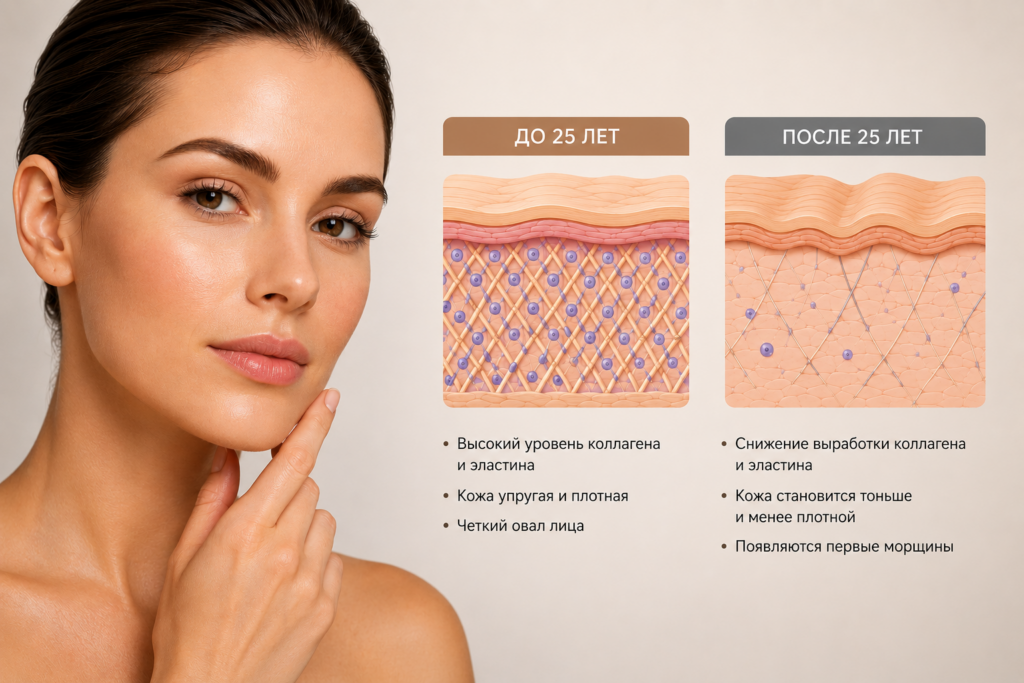
From about age 25, the body begins producing less collagen and elastin, the proteins responsible for skin firmness and tone. The process is gradual but unavoidable: the skin becomes thinner, loses density, and the first wrinkles appear. Poly-L-lactic acid is one of the few tools in aesthetic medicine that addresses this underlying cause rather than its consequences.
What Is Poly-L-Lactic Acid
Poly-L-lactic acid (PLLA) is a biodegradable polymer derived from lactic acid, a substance the human body produces naturally. This means the product is fully compatible with the tissues and over time breaks down into safe metabolic byproducts, carbon dioxide and water, leaving no residue.
In aesthetic medicine, PLLA works differently from conventional fillers. Hyaluronic acid fills space and retains moisture, which gives a fast but temporary effect. Poly-L-lactic acid acts as a biostimulator: rather than simply filling wrinkles, it prompts fibroblasts, the cells responsible for producing collagen, elastin and hyaluronic acid, to become active.
How Collagen Production Is Triggered
Once injected into the dermis, the product’s microparticles cause a controlled, low-intensity inflammatory response. This signals the body to start a repair process. Fibroblasts are activated and begin producing new collagen fibers around the particles, gradually forming a dense collagen framework. As the PLLA biodegrades, the patient’s own collagen takes its place.
This is why the result of poly-L-lactic acid is described as natural: the skin is rejuvenated through its own resources rather than through an injected substance.
What Changes in Your Appearance
New collagen fibers make the skin denser, improve its surface and restore volume in areas where the tissues have sagged. Visible effects include smoother wrinkles and creases, a lifted facial contour, improved skin texture, and correction of post-acne marks and scars. PLLA-based products also stimulate the skin’s own hyaluronic acid production, which improves hydration from within.
Who the Procedure Is Suitable For
Poly-L-lactic acid is suitable for both women and men with any skin type. It is most indicated for loss of tone and firmness, a less defined facial contour, deep wrinkles and creases, and for those who want a long-lasting result without surgery. Contraindications include pregnancy, breastfeeding, autoimmune connective tissue diseases and acute inflammatory skin conditions.
When Results Appear After Poly-L-Lactic Acid Injections
The main reason for disappointment after PLLA is unrealistic expectations. Patients expect an immediate result, as with hyaluronic acid fillers, but poly-L-lactic acid works in a fundamentally different way. It is a biostimulator: its job is not to fill but to trigger. Here is how the effect develops over time.
On the day of the injections, the skin may look fuller, but this is due to swelling and the injected solution, not an actual result. The swelling subsides within a few days, and for a while the skin returns to how it looked before. Many patients worry at this point that the procedure has not worked, when in fact the process is only beginning.
Fibroblasts need time to respond to the biostimulator and start producing new collagen fibers. The first changes, such as better skin quality and texture and slight firming, become noticeable about 3–8 weeks after the procedure. The skin looks fresher, the tone evens out, and it feels denser.
The maximum result is reached 2–3 months after the course is completed, once the collagen framework has fully formed. This is when the lifted facial contour, smoother wrinkles and restored volume become noticeable. The effect looks natural, as the skin changes gradually, without abrupt transitions.
How Long the Result Lasts
On average, the effect lasts 18–30 months, considerably longer than hyaluronic acid fillers, which last 6–12 months. This is because the result comes from the patient’s own collagen rather than an injected substance.
Maintenance treatments are planned 18–24 months after the initial course. By then, the collagen framework begins to break down naturally, and a short course of 1–2 sessions refreshes the result.
What Affects How Quickly Results Appear
The timing depends on the patient’s age, the initial condition of the skin, lifestyle and how closely the doctor’s aftercare recommendations are followed. In older patients, fibroblasts work more slowly, so the result may appear somewhat later, but it lasts just as well.
Can Poly-L-Lactic Acid Be Combined with Other Injections
A common question during consultations is: “I already have Botox and fillers. Is there any point in adding poly-L-lactic acid? Won’t they interfere with each other?” The answer is that they will not interfere, and in fact they enhance the result. The key is getting the sequence right.
Poly-L-lactic acid addresses something neither Botox nor hyaluronic acid fillers can: it restores the quality of the skin itself, including its density, structure and collagen framework. Botulinum therapy relaxes the muscles and smooths dynamic wrinkles. Fillers replace volume and correct contours. PLLA works deeper, at the level of the dermis, triggering neocollagenesis. These are different mechanisms that complement rather than duplicate each other.
What Poly-L-Lactic Acid Can Be Combined With
With botulinum therapy: one of the most common and effective combinations. Botox relaxes facial expression lines, while PLLA restores skin structure. Together they reinforce each other: the Botox result looks more natural against firmer, more elastic skin.
With mesotherapy and biorevitalization: a good combination for improving skin quality overall. Mesotherapy delivers active ingredients to the skin, while PLLA triggers long-term biostimulation.
With PDO threads: PLLA and threads work at different tissue levels and enhance each other’s lifting effect.
With device-based treatments: RF lifting and ultrasound SMAS therapy combine well with poly-L-lactic acid, since the thermal effect provides additional stimulation to fibroblasts.
What Should Not Be Combined
Poly-L-lactic acid is not recommended in the same area at the same time as hyaluronic acid fillers, as this can affect how the product is distributed. It is also best not to have several injectable procedures on the same day: the tissues need time to recover between treatments.
How to Plan the Right Sequence
There is no one-size-fits-all scheme; the protocol is always tailored to the individual. Typically, botulinum therapy or filler correction comes first, and the PLLA course begins 2–3 weeks later. The reverse order is also possible. The key condition is having one doctor who sees the full picture and oversees every stage of treatment.
If you would like to find out whether this procedure is right for you, book a consultation with a Medest cosmetologist. The specialist will create an individual treatment plan based on the condition of your skin and your goals.