Ingrown Hairs and Shaving Irritation: Why They Develop and When Laser Hair Removal Can Help
An ingrown hair develops when a cut hair shaft curves and grows back into the skin or fails to emerge through the follicular opening. It can cause itchy papules, sometimes with pustules and residual marks. Laser hair removal reduces the number of hairs and the repeated trauma of shaving and may therefore help with pseudofolliculitis. Folliculitis, acne, and other skin conditions should first be excluded.
Why Inflamed Bumps Appear After Shaving
Coarse, curly hairs are particularly prone to becoming ingrown. After a very close shave, the sharp tip may re-enter the skin. The risk is increased by stretching the skin, shaving against the direction of growth, repeatedly passing over the same area, using a blunt blade, and wearing tight clothing that constantly rubs the treated area.
Sugaring, waxing, and epilators can also trigger ingrown hairs. Attempting to squeeze the lesion or remove the hair with a needle increases inflammation and the risk of infection, scarring, and post-inflammatory hyperpigmentation.
Pseudofolliculitis is an inflammatory reaction to a hair within the skin and is not necessarily an infection. However, the follicle can become secondarily infected. Increasing pain, pus, a large area of redness, or fever requires medical assessment.
Areas Where the Problem Occurs Most Often
Ingrown hairs are typical in areas where hair is removed regularly: the face and neck in men, the chin in women, the underarms, bikini area, lower legs, and thighs. Inflammation on the neck and in the bikini area is often aggravated by friction from a collar or underwear. Brown or greyish marks may remain after healing, particularly in skin prone to post-inflammatory hyperpigmentation.
Similar lesions may occur with acne, dermatitis, and infectious folliculitis. Pronounced growth of coarse facial hair in women may have a hormonal cause; laser treatment reduces hair but does not replace diagnostic assessment.
What to Do with a Single Ingrown Hair
- Temporarily stop shaving, waxing, or plucking the inflamed area.
- Do not puncture or squeeze the lesion.
- Reduce friction from clothing and do not cover the area with a thick occlusive product.
- Use gentle cleansing without a scrub or alcohol.
- Consult a dermatologist if there are multiple papules, pus, pain, or recurrent marks.
The physician may prescribe topical anti-inflammatory, antimicrobial, or keratinisation-regulating products. Selection depends on the diagnosis; an antibiotic or strong acid should not be applied “just in case”.
How to Shave to Reduce the Risk of Ingrown Hairs
- Soften the hair with water and use a suitable gel without irritating fragrances.
- Do not stretch the skin, and move the razor in the direction of hair growth.
- Use short strokes and do not pass repeatedly over the same area.
- Use a clean, sharp blade or consider an electric trimmer.
- Do not aim to remove the hair exactly level with the skin; leaving a short shaft reduces the likelihood of the hair growing back into the skin.
- Do not rub the skin after shaving, and avoid tight clothing.
These measures reduce trauma but may not fully resolve the problem in coarse, curly hair. If irritation returns after every shave, the physician may discuss long-term hair reduction with a laser.
When Laser Hair Removal Can Help
Laser light is absorbed by melanin in the hair and converted into heat, damaging structures within the follicle. After a course of treatment, the number of dark hairs decreases, remaining hairs often become finer, and shaving is needed less frequently. This reduction in hair and episodes of mechanical trauma helps control pseudofolliculitis.
Laser treatment does not remove an established scar or immediately lighten every mark. It is also less effective for grey, white, very light, and some red hair because these contain little of the target pigment. Several sessions are required because follicles are in different phases of growth and do not respond to treatment at the same time.
Can Laser Treatment Be Performed on Inflamed Skin?
Active pustules, open wounds, herpes, marked irritation, and infection are treated first. The specialist assesses whether adjacent areas can be treated safely or whether the entire procedure should be postponed. Crusts must not be shaved off or inflammation concealed before the appointment.
Before the course, disclose any medicines, recent tanning, and a tendency to pigmentation or scarring. Tanned or sunburned skin requires a delay because additional melanin in the epidermis increases the risk of burns and pigmentary change.
Which Devices Are Used at Medest
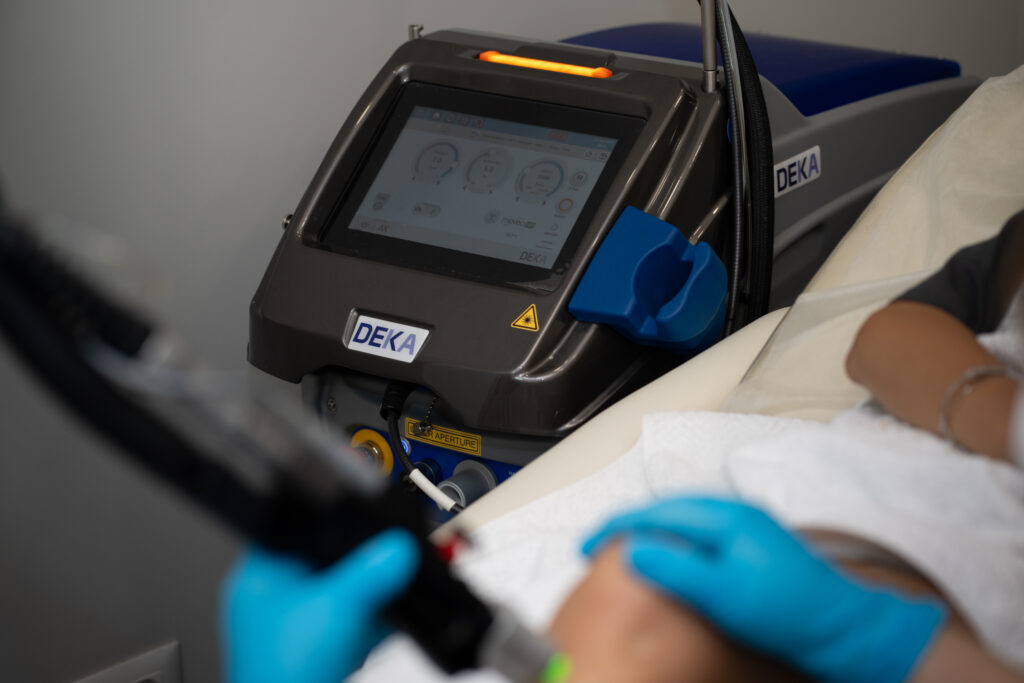
At Medest, laser hair removal is performed with the CANDELA GentleLase Pro and DEKA Motus AX. GentleLase Pro is a 755 nm alexandrite system with dynamic cooling. DEKA Motus AX uses Moveo alexandrite technology with in-motion treatment. The clinic can also combine the devices within one treatment plan.
Five Factors in Selecting the Device and Parameters
- Skin phototype and the presence of a tan determine which parameters can be used safely.
- Hair colour and thickness affect the hair’s ability to absorb laser energy.
- Treatment area and hair depth require different settings and techniques.
- Active inflammation may be a reason to postpone the procedure.
- The skin’s previous response helps the specialist adjust to the next session.
The device should not be selected solely by its name or by how painful it feels. The specialist considers the skin phototype, hair, treatment area, and current skin condition and may perform a test exposure when necessary.
What to Do Between Sessions
Hair may be shaved between sessions if the skin is not inflamed. Waxing, sugaring, epilators, and tweezers remove the target from the follicle and interfere with the next laser treatment. After the procedure, the area is temporarily protected from overheating, friction, and sunlight; the specialist provides the exact time frames.
Book a consultation at Medest if ingrown hairs and shaving irritation recur. The physician will rule out active skin disease, and a laser hair removal specialist will select CANDELA or DEKA and plan the course. If there are no contraindications, you can book laser hair removal in Yerevan.
| Code | Service name | Cost, ֏ |
|---|---|---|
| A14.01.013 |
A14.01.013
Arms, for women (CANDELA) |
15 000 |
| A14.01.013 |
A14.01.013
Chest, for women (CANDELA) |
20 000 |
| A14.01.013 |
A14.01.013
Face and neck, for women (CANDELA) |
15 000 |
| A14.01.013 |
A14.01.013
Deep Bikini, for women (DEKA) |
15 000 |
| A14.01.013 |
A14.01.013
Arms (above or below elbow), for women (DEKA) |
8 000 |
| A14.01.013 |
A14.01.013
Arms, for women (DEKA) |
13 000 |