Painful Callus or Corn: Why It Returns and When to Consult a Podologist
Calluses and corns develop in response to repeated pressure and friction. Removing the layer of hardened skin reduces pain, but the problem returns if the cause remains: tight footwear, toe deformity, gait characteristics, or overloading of a particular area of the foot. A podologist does more than reduce hyperkeratosis: the specialist identifies the pressure point, distinguishes a corn from a plantar wart, and helps reduce repeated loading.
The Difference Between a Callus and a Corn
A callus is a broader, flatter area of thickened skin. It commonly develops beneath the metatarsal heads, on the heel, or along the edges of the foot. A corn is usually more compact and has a dense central cone that extends inwards and may press on sensitive tissues. A small corn can therefore be more painful than a large callus.
Soft interdigital corns develop where the toes rub against each other and the skin remains moist. Hard corns are more often located over bony prominences. The location provides information about loading, but diagnosis still requires an examination.
Callus. A broad, flat thickening with a burning sensation when walking. The specialist reduces the layer of hyperkeratosis and assesses loading.
Corn. A dense centre with pain on direct pressure. The podologist carefully removes the keratinised core.
Plantar wart. It may disrupt the natural skin lines and hurt when compressed from the sides. Differential diagnosis and, when necessary, referral to a physician are required.
Fissure. A linear split in thick, dry skin. The specialist treats the edges and selects appropriate protection.
Diagnosis should not be based solely on “black dots” or the shape seen in a photograph. A wart, foreign body, cyst, or inflamed area may resemble a corn. If there is uncertainty, the podologist will refer the patient to a dermatologist or another specialist.
Why a Corn Returns
The skin thickens to protect itself from mechanical stress. If the patient returns to the same narrow footwear after treatment or continues to place weight on the painful point, the protective response begins again. In some cases, the cause is associated with hammer toes, a prominent bunion, flat feet, or altered gait following an injury.
Another factor is excessively aggressive self-treatment. Blades, scissors, and deep filing damage living skin, cause inflammation, and may increase the build-up of the thickened layer. Acid-based corn plasters can damage the surrounding skin, particularly in people with diabetes, impaired sensation, or poor circulation.
When a Podologist Is Needed
- Pain interferes with walking, wearing usual footwear, or exercising.
- The thickened area returns in the same location.
- A dense core is visible in the centre, or the diagnosis is uncertain.
- A fissure, bleeding, weeping, redness, or discharge has developed.
- The lesion is located between the toes or beside a nail.
- Diabetes, neuropathy, impaired circulation, or an immune disorder is present.
With diabetes and reduced sensation, severe pain must not be used as a warning sign: the patient may not notice damage or infection. Any wound or change in the colour or temperature of the foot should be shown to a physician.
How a Medical Pedicure Is Performed at Medest
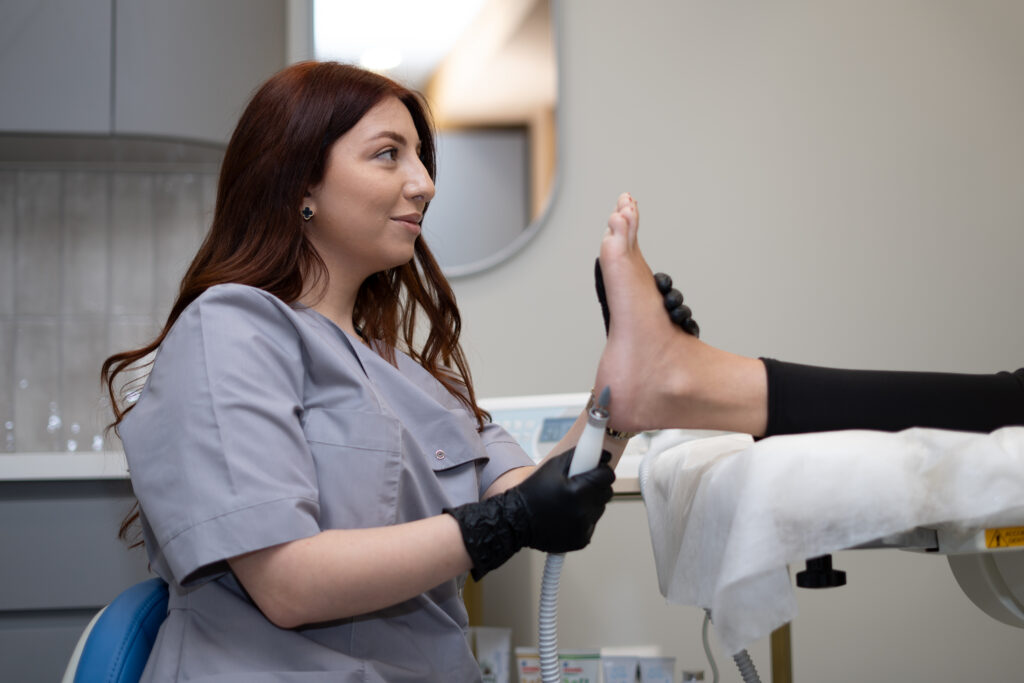
A medical pedicure differs from an aesthetic pedicure because it addresses pathological changes in the skin and nails. The podologist examines the foot, discusses the symptoms, and assesses footwear and pressure areas. The specialist then safely reduces hyperkeratosis with professional devices and treats corns, fissures, and nail changes when indicated.
At Medest, the procedure includes cleansing, softening of keratinised skin, treatment of the toes and nails, work on the foot, and final professional support. For a corn, the specialist removes the dense keratinised tissue layer by layer without cutting healthy skin. If there are signs of infection, a wart, or an orthopaedic concern, the podologist recommends consultation with the appropriate physician.
What to Do After Corn Removal
- Follow the recommendations for offloading the treated point.
- Choose footwear according to its length, width, and toe-box height, not only the size printed on the box.
- Use a protective pad or custom insole if recommended by the specialist.
- Keep the skin supple with a professionally selected product, without applying a thick cream between the toes.
- Do not cut away a returning layer yourself, and attend the follow-up at the specified time.
An offloading pad helps redistribute pressure but does not correct a pronounced deformity. If the corn is related to foot biomechanics, an orthopaedic consultation and custom orthoses may be required.
Can the Core Be Removed Permanently in One Visit?
The podologist can fully treat the accessible keratinised core, but cannot promise that the corn will never return. Recurrence depends on loading. The more effectively pressure, friction, and unsuitable footwear are addressed, the longer the result is likely to last. With a persistent deformity, the goal is to control the problem and prevent pain and skin damage.
What Should Be Avoided
Do not soak a painful corn until the skin becomes macerated, puncture it, or cut out the centre. Do not use strong keratolytic products on damaged skin. If redness, throbbing pain, pus, or fever is present, cosmetic treatment is not a substitute for medical care.
Book a consultation with a Medest podologist if a callus or corn is painful and keeps returning. The specialist will identify the type of lesion, treat the foot safely, and prepare an offloading plan. When indicated, you can book a medical pedicure and corn removal in Yerevan at the same time.
| Code | Service name | Cost, ֏ |
|---|---|---|
|
Hardware pedicure and callus removal |
from 15 000 |