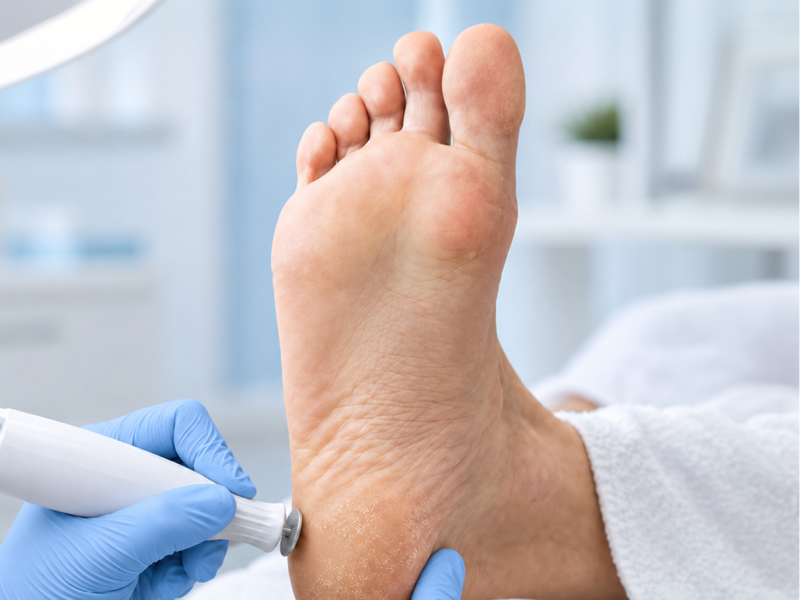

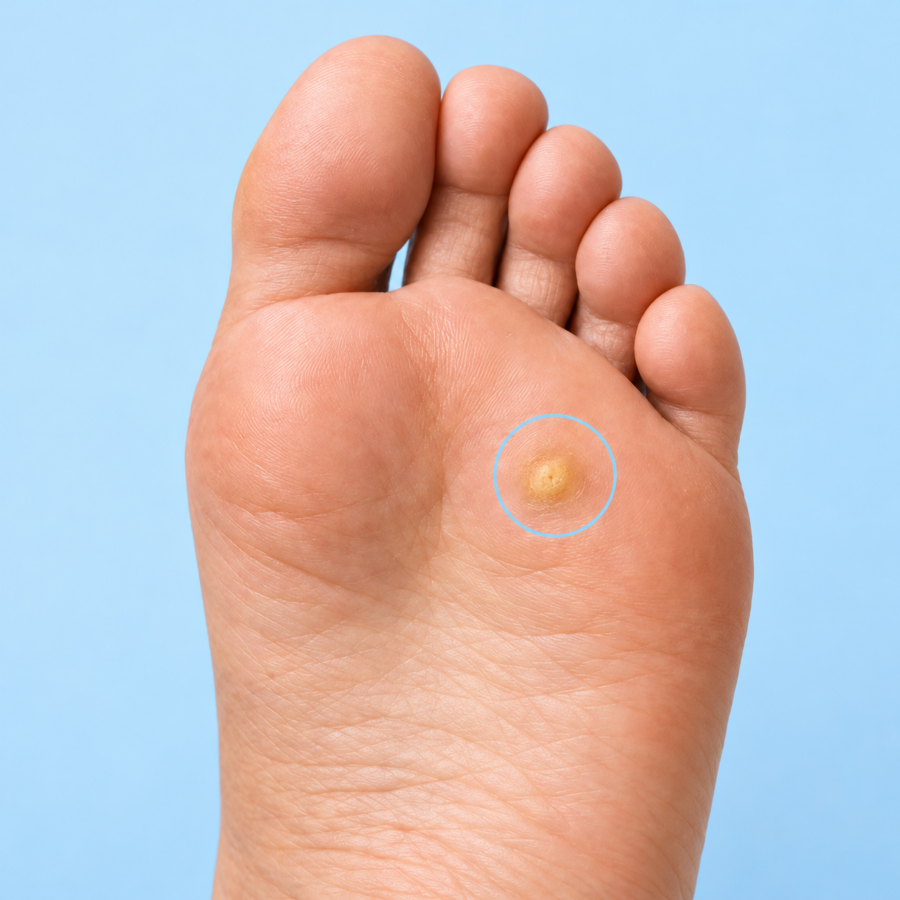
A corn forms in an area exposed to chronic pressure or friction. The dense area of keratinized skin extends inward and may cause sharp, localized pain under load. If only the thickened tissue is removed while the source of pressure remains, the corn commonly returns.
The podiatrist’s role is not limited to treating the painful area. It is also necessary to determine why pressure is concentrated at that point, whether because of narrow footwear, toe deformity, gait mechanics, a bony prominence, or thinning of the foot’s cushioning fat pad.
Why Does a Corn Recur?
The skin responds to persistent mechanical stress by increasing keratinization. A localized thickening appears first, followed by a dense central cone. When walking, this presses on the deeper tissues and causes pain even if the visible lesion is small.
Cutting the corn at home may provide brief relief but creates a risk of injury and infection. Acid-containing corn plasters are also unsuitable for some patients, particularly those with diabetes, reduced sensation, or impaired circulation.
How Is a Corn Different from a Plantar Wart?
A plantar wart is associated with human papillomavirus, whereas a corn develops because of mechanical pressure. In a wart, the normal skin lines are often interrupted and thrombosed capillaries may be visible. A corn is usually clearly related to a pressure point and has a dense keratinized center.
The two conditions cannot always be distinguished by appearance alone. If there is uncertainty, the specialist examines the lesion and may refer the patient to a dermatologist. A suspected wart should not be treated as an ordinary corn without diagnosis.
What Does Podiatric Treatment Involve?
- Examination of the foot, footwear, and painful area.
- Assessment of sensation, circulation, and relevant medical conditions.
- Controlled removal of excess keratinized tissue without injuring healthy skin.
- Selection of temporary or long-term offloading.
5. Advice on footwear and the timing of follow-up.
Medest provides corn treatment and removal. When a corn repeatedly returns, the specialist addresses both the lesion and its mechanical cause.
Offloading Devices and Their Purpose
| Device | Primary purpose | Typical use |
| Silicone toe separator | Separates the toes and reduces friction | Contact between adjacent toes |
| Protective ring | Relieves direct pressure on a painful point | Temporary offloading of a localized corn |
| Pad or insert | Redistributes pressure | Forefoot overload |
| Custom insole | Modifies pressure distribution | Persistent biomechanical causes |
An offloading device must be positioned correctly. If it shifts or creates a new pressure point, symptoms may become worse.
Maintaining the Result of Treatment
After the procedure, the specialist may recommend a product to help control hyperkeratosis. Gehwol Callus Cream contains keratolytic ingredients and may be included in a professionally selected regimen. It should not be applied to an open wound or used without supervision in a diabetic foot.
Footwear should also have adequate width in the toe box and a stable sole. If toe deformity is pronounced, an orthopedic consultation may be required.
Why Should a Corn Not Be Repeatedly Drilled Deeper?
The painful area is not a “root” growing from within. It is dense tissue that has developed in response to pressure. Attempting to remove it as deeply as possible may damage living skin and create a wound, particularly if the patient continues to wear the same footwear.
Appropriate treatment ends once excess keratinized tissue has been removed and pressure has been reduced. Further improvement depends on offloading and tissue recovery, not on a more aggressive procedure.
Assessing Footwear and Gait
It is useful to bring the shoes worn most often to the appointment. Wear patterns, toe-box width, and seam placement can help identify the source of friction. Sometimes a small footwear adjustment is more effective than repeated treatment.
If corns occur symmetrically on both feet or are accompanied by joint pain, the specialist assesses biomechanics and may refer the patient to an orthopedic physician. Each offloading device should address a specific mechanical problem.
Frequently Asked Questions
Can the Central Core Be Removed in One Appointment?
The main area of dense tissue can often be removed during one treatment, but the outcome depends on its depth and the condition of the skin. Without offloading, the corn may form again.
Why Can Pain Remain After Treatment?
The tissues beneath the corn may have been under pressure for a long time. If pain does not decrease or becomes worse, repeat assessment is needed to rule out inflammation or another cause.
Will an Acid Corn Plaster Help?
It may soften keratinized tissue, but it can also damage the surrounding skin. Unsupervised use is particularly risky in diabetes, reduced sensation, or impaired circulation.
When Is an Orthopedic Consultation Needed?
For pronounced toe deformity, recurrent corns in the same area, changes in gait, or the potential need for custom insoles.
If a corn keeps returning or makes walking painful, book an appointment at Medest. The podiatrist will treat the area carefully, assess pressure distribution, and select an offloading method to reduce the risk of recurrence.