Ingrown Toenail: How to Treat It Without Surgery and When to See a Podologist
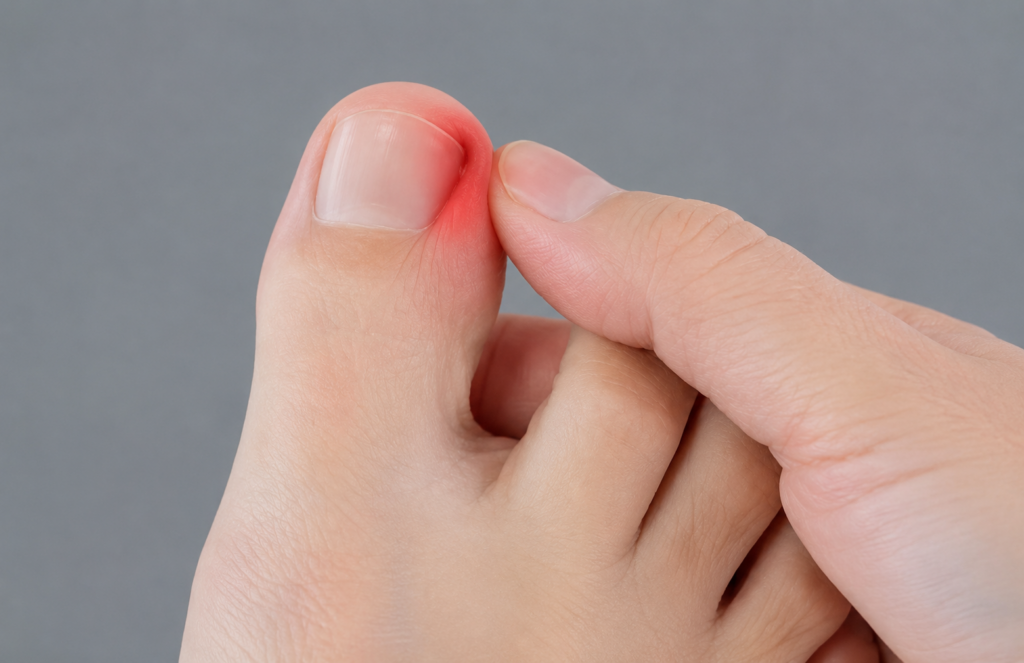
Pain with every step, redness around the nail fold, and the feeling that the nail is “cutting into” the skin are all common signs of an ingrown toenail. This condition is widespread: according to medical statistics, approximately one in three people experiences onychocryptosis (the medical term for an ingrown nail) at least once in their lifetime. The good news is that, in most cases, an ingrown toenail can be treated without surgery — with the help of a podologist.
Why Toenails Become Ingrown: Main Causes
An ingrown toenail occurs when the edge of the nail plate begins to grow into the surrounding skin of the toe. There are several possible causes:
- Improper nail trimming — rounding the corners instead of cutting straight across
- Tight or unsuitable footwear — creating pressure on the toes
- Congenital nail or toe shape особенности
- Foot injuries — bruises or heavy objects falling on the foot
- Excess body weight — increasing pressure on the feet
- Fungal nail infection — changing the structure and growth of the nail
Symptoms of an Ingrown Toenail
The condition usually develops gradually. At first, there may only be mild discomfort around the nail fold. Over time, the following symptoms can appear:
- Pain while walking, worsening when pressure is applied to the toe
- Redness and swelling of the nail folds
- Pus or discharge — indicating infection
- Overgrowth of hypergranulation tissue (commonly called “proud flesh” or “wild flesh”)
If signs of infection appear — such as pus or fever — medical attention should be sought immediately, as urgent treatment may be required.
Conservative Treatment by a Podologist
In the early stages, a podologist can gently release the ingrown edge of the nail, treat the surrounding skin, apply antiseptic products, and provide recommendations for proper nail care at home.
This approach is highly effective when treatment begins early.
When Surgery May Be Necessary
In some cases, conservative treatment is not enough:
- Advanced inflammation with significant infection
- Spread of infection to bone tissue
- Recurrent ingrown nails that do not respond to conservative treatment
In such situations, the podologist may refer the patient to a surgeon. Modern surgical techniques are minimally invasive and are usually performed under local anesthesia.
How to Trim Nails Properly to Prevent Ingrown Toenails
Prevention largely depends on correct nail-cutting technique:
- Cut the nail straight across without rounding the corners
- Leave the nail slightly longer than the tip of the toe
- Use sharp, clean nail clippers or scissors
- Choose shoes with enough room in the toe box
If an ingrown toenail is accompanied by nail discoloration, splitting, or odor, this may indicate a fungal infection. We recommend reading our article about fungal nail and foot treatment. Ingrown toenail treatment is part of complex podology care at Medest Clinic. часть комплексного подологического ухода в клинике Medest.
| Code | Service name | Cost, ֏ |
|---|---|---|
|
Hardware pedicure and callus removal |
from 15 000 | |
|
Medical hardware pedicure, diabetic foot |
from 25 000 | |
|
Medical hardware pedicure, normal with mild problems |
15 000 | |
|
Medical hardware pedicure, psoriasis and damaged nails |
45 000 |